KRRRD
AI website builder experiment
I built this project in March 2024 to test what I knew and get serious practice with spec-driven development. The idea was simple: a platform that lets you create websites from a text prompt.
How it worked
I hosted everything on a Hetzner server. The first version was in PHP, then I rewrote it in Python when I realized I needed more flexibility. The system used both proprietary AI APIs and self-hosted models, depending on what was needed.
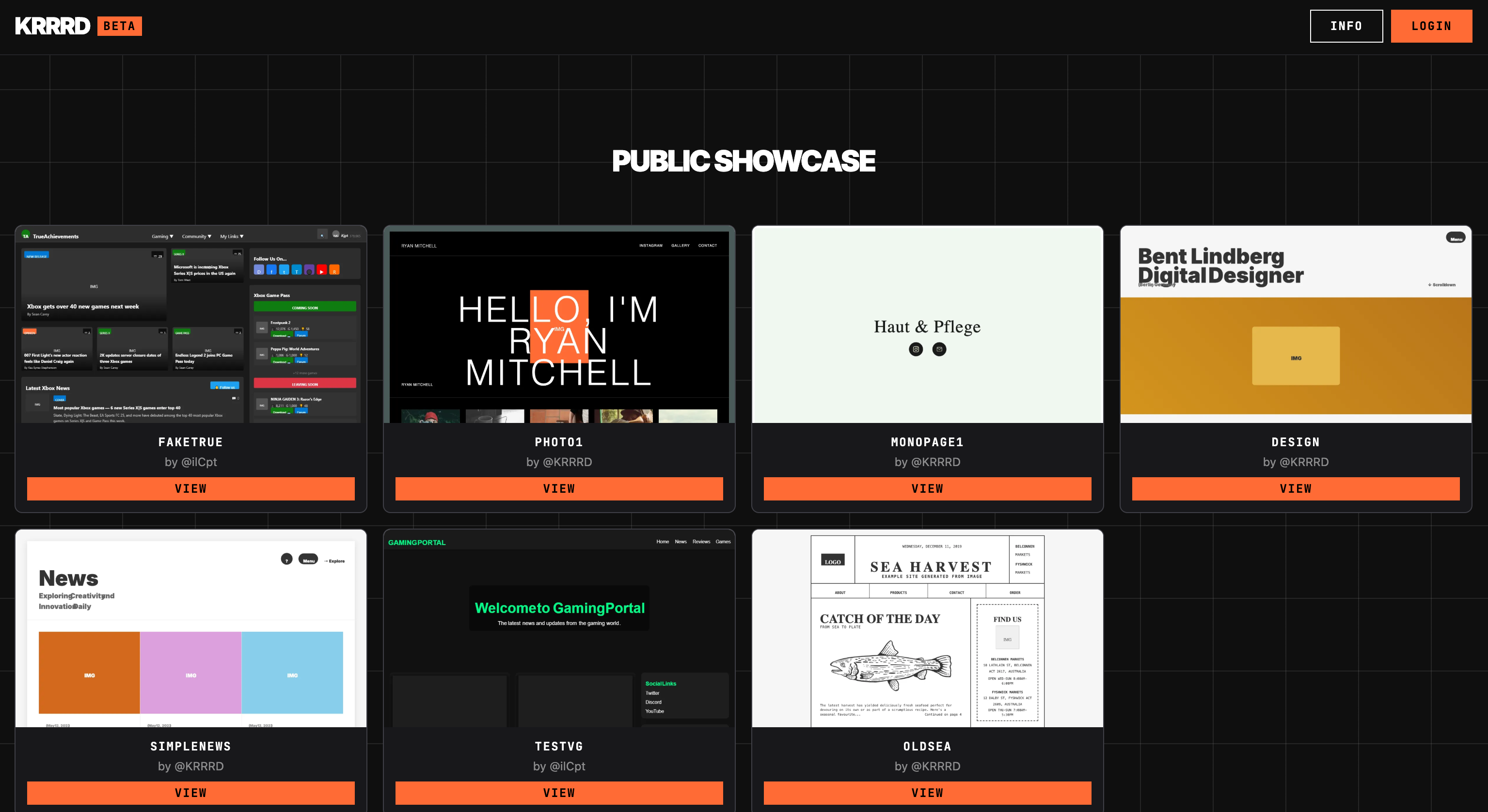
You'd write a prompt describing the site you wanted, the AI generated the code, and the system parsed it to create the pages. No templates: every time the code was generated from scratch to give users more creative freedom.
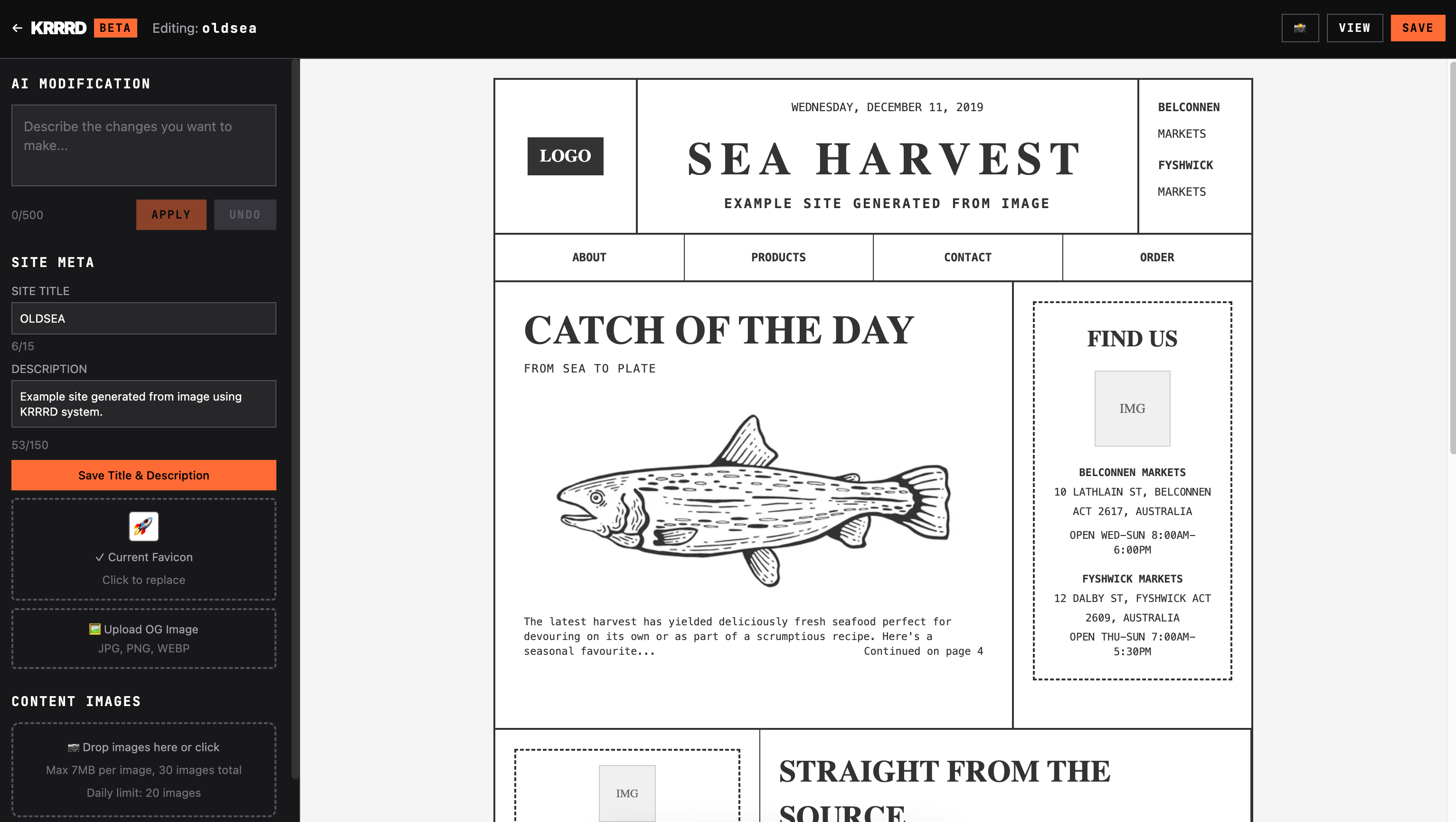
There was also an edit function that let you modify the site through AI. You could upload images, fonts, customize everything. The system understood what you wanted to change and rewrote the necessary parts.
What made it interesting
Wildcard Domains
I implemented a wildcard of krrrd.com (no longer available), with the option to add custom domains. Each user got their own automatic subdomain.
Multiple Input Methods
I added APIs to create sites from screenshots and from URLs. The latter scraped the page and added a code simplification layer to avoid sending massive prompts to the AI.
Fork Mode
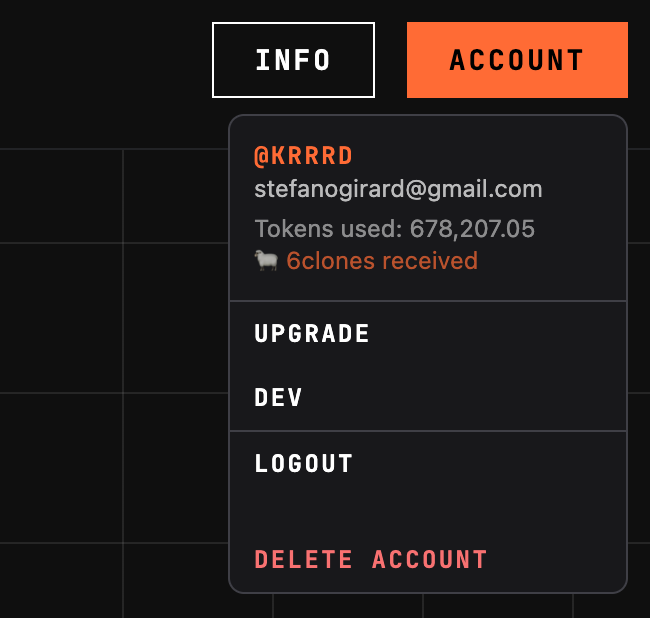
Users could make their sites public and others could clone them as a starting point. Each fork had its counter to track usage.
Dev Mode
For those who wanted more control, there was a dev mode where you could use your own API keys or directly your own self-hosted model.
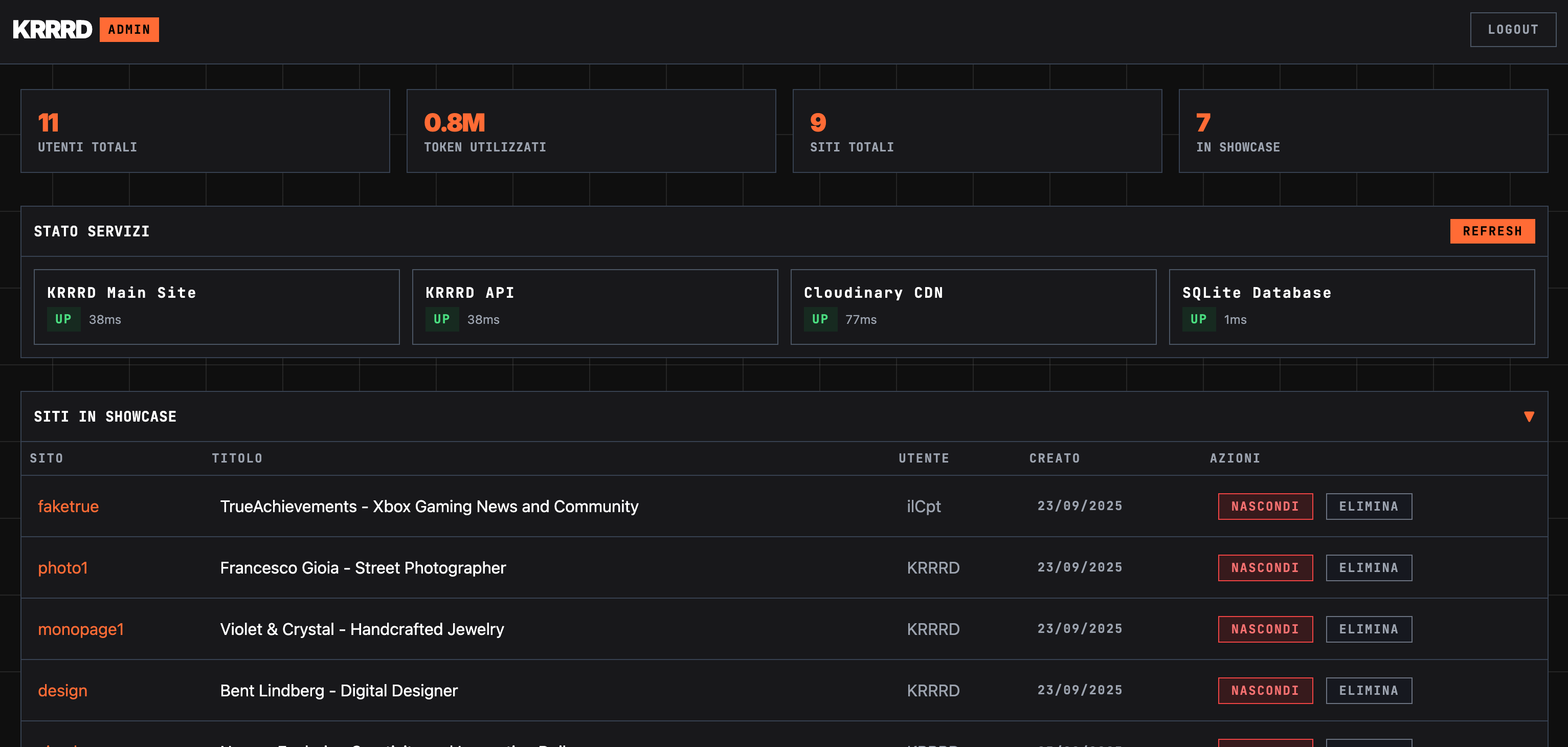
I also built an admin page to manage the whole thing: usage tracking, counters, security checks, and all the tools you need to run a platform like this. It gave me a full view of what was happening: who was generating sites, resource usage, potential abuse, the whole picture.
Why I stopped
The project ended due to lack of funds. Hosting everything, especially with AI API costs, wasn't sustainable without investment.
Today, platforms like Pagesmith, v0.dev, and Bolt.new offer similar AI-powered website building capabilities. While working on KRRRD and studying these platforms, I discovered fundamental problems with this approach:
This contributes to what I call web desertification: a phenomenon that started well before AI. People abandon their websites and platforms because maintaining them requires continuous technical and financial effort. The barrier to entry keeps rising, and eventually, people give up.
With significantly less technical effort and much lower costs, you can build products that are far more maintainable and modifiable, even for non-technical users.
The thinking behind it
A complex platform that enables the creation of very light and simple sites.
The web is massively over-engineered. Landing pages built in React for no reason, frameworks stacked on frameworks, complexity that increases costs and worsens accessibility.
With KRRRD, I built the admin platform in React because it needed real interactivity. But the generated sites were pure HTML, CSS, and minimal JavaScript: light, fast, accessible. The platform was complex so the output could be simple.
Not everyone needs deep customization. But with the right approach, you can deliver maintainable, modifiable products at a fraction of the cost and technical overhead.
A different approach
My focus now is on providing tools that work: technologies with decades of proven reliability. Simple, battle-tested solutions instead of chasing the latest trend.
Rather than building another platform that does everything for users, I want to teach people to use AI to build websites themselves. No unnecessary automation, no artificial complexity, no lock-in.
I handle security, best practices, and infrastructure. Users get simple, maintainable websites they actually understand.
Hosting at €1-2/month, sometimes less. Static files don't need expensive infrastructure. No artificial subscription costs, no vendor lock-in pricing.
When you need help (design work, corrections, improvements, branding, technical features that require platform integration), these are services you pay for once, not monthly fees for software sitting on a server.
The goal isn't to do it for them. It's to give them the tools and knowledge to do it themselves, sustainably. And when they need professional help, they pay for actual work, not for access.
Because that's how you fight web desertification: lower the barrier to entry, reduce maintenance overhead, eliminate recurring costs that aren't justified, and make ownership actually meaningful.